Pediatric Travel Health: Keeping Kids Safe from Italy’s Heatwaves ("Ondate di Calore")
Updated: Jul 21

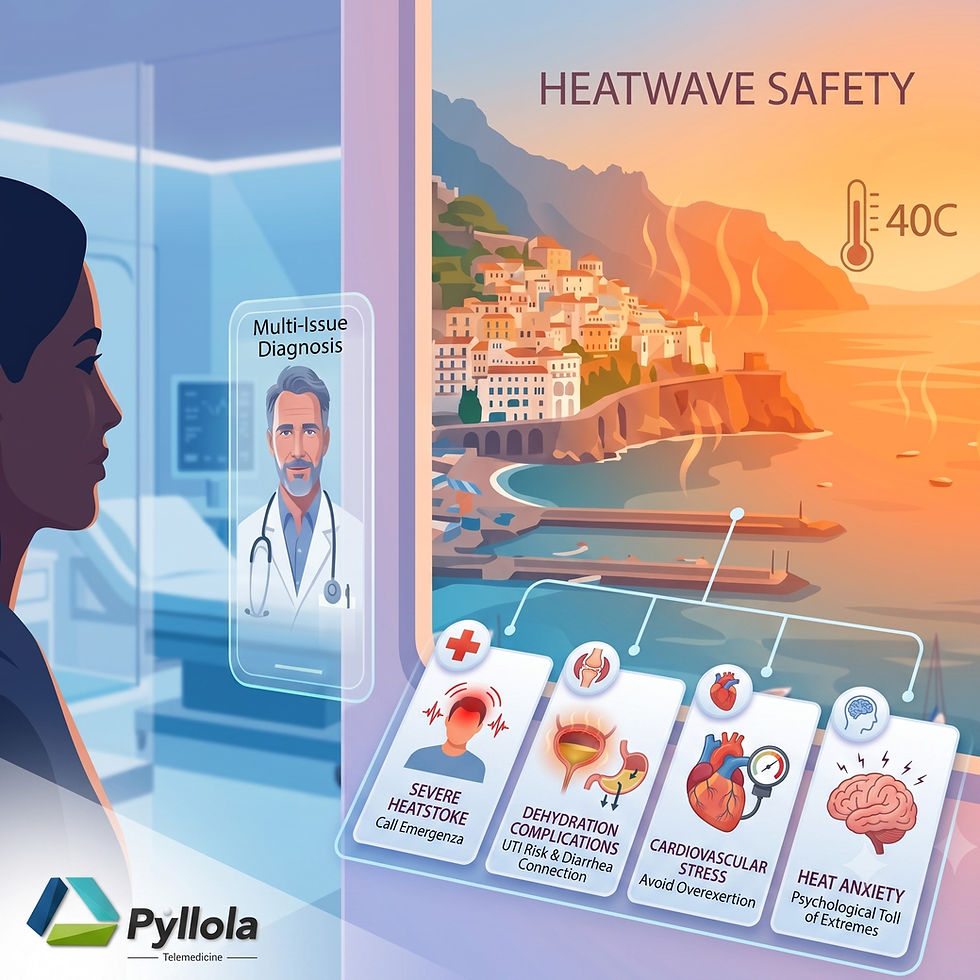
Italy in summer is magical, but the current record-breaking heatwave presents acute challenges, especially when traveling with small children. Parents must understand that infants and toddlers are at significantly higher risk during ondate di calore than adults. This post provides the essential, public-interest information parents need to navigate the Italian sun safely with their family.
1. The Physiological Shift: Why Kids Lose Water Faster
Infants and young children are at a distinct physiological disadvantage when exposed to ambient temperatures approaching 40°C (104° F). They are not simply "small adults"; their thermoregulatory and fluid balancing systems are anatomically immature.
Surface Area-to-Mass Ratio
Children possess a much higher body surface area-to-mass ratio (BSA/M) than adults. While a high ratio helps dissipate heat in normal zones, it backfires in extreme ambient heat. When air temperatures exceed the body's skin temperature, the direction of heat transfer reverses: the child absorbs environmental heat much faster than an adult.
Immature Sudoromotor Function
A child's cooling capacity via evaporative sweat loss is limited. Children have an immature sweat-gland response (sudoromotor system). They produce less sweat per gland compared to adults and require a higher core body temperature threshold to trigger sweating in the first place. At 40°C, a small body can move from stable hydration to acute dehydration in just a few hours.
Elevated Metabolic Demand
Children have a higher baseline metabolic rate, meaning they naturally generate more internal metabolic heat per unit of body mass. Combined with a lower blood volume reserve, their core temperature can rise up to three to five times faster than an adult's when exposed to heat stress.
📚 Reference: American Academy of Pediatrics (AAP) Policy Statement. "Climatic Heat Stress and Exercising Children and Adolescents." Pediatrics. (Documenting that children absorb heat faster due to BSA/M ratios and have lower sweat rates per gland than adults).
2. Clinical Signs of Pediatric Dehydration
Because infants and toddlers are non-verbal or lack the cognitive awareness to identify and communicate early thirst signals, caregivers must monitor for distinct physical markers of dehydration.

Indicators in Infants (Under 1 Year)
The Sunken Fontanelle: The anterior fontanelle (the soft spot on an infant's skull) serves as a visual pressure indicator for underlying systemic fluid volumes. When an infant enters moderate to severe states of dehydration, hydrostatic pressure drops across the extracellular fluid compartments, causing the fontanelle to noticeably sink or curve inward.
Sticky or Dry Mucous Membranes: Salivary production decreases sharply as the body attempts to conserve water. Checking the moisture baseline inside the infant’s lips and gums is a reliable physical check.
Oliguria (Decreased Diaper Output): A healthy infant typically saturates six to eight diapers every 24 hours. A reduction to fewer than six wet diapers, or a diaper that has remained completely dry for over four to six hours, indicates the kidneys are aggressively conserving fluid due to systemic volume deficits.
📚 Reference: World Health Organization (WHO). "The Treatment of Diarrhoea: A manual for physicians and other senior health workers." (Providing the clinical classification thresholds for mild, moderate, and severe dehydration markers in pediatric populations).
Indicators in Toddlers (1 to 3 Years)
Lethargy and Altered Mental Status: Early dehydration can manifest as irritability, but as volume depletion progresses to moderate or severe stages, it transitions into lethargy. This is caused by reduced cerebral perfusion and systemic exhaustion as the body struggles to maintain blood pressure. A toddler who is unusually listless, difficult to rouse, or completely lacks the energy to engage with their surroundings requires immediate evaluation.
Absent Tear Production (Aacrymia): Lacrimal glands require adequate extracellular fluid volume to synthesize and release tears. If a toddler cries intensely due to distress or heat discomfort but produces no visible tears, it is a key diagnostic indicator of a significant fluid deficit.
Hyper-Concentrated Urine: As fluid reserves plummet, the kidneys excrete highly concentrated urine rich in cellular waste. If a toddler urinates infrequently and the urine appears dark amber or orange, severe under-hydration is present.
📚 Reference: National Institute for Health and Care Excellence (NICE). "Diarrhea and vomiting caused by gastroenteritis in children younger than 5 years: diagnosis and management." (Establishing clinical guidelines for assessing dehydration via tear production, mental baseline status, and urinary changes).
3. Practical Travel Hydration & Cooling Strategies
Safe Formula and Fluid Delivery
For infants under six months, breastmilk or formula provides all necessary hydration; extra water is rarely recommended as it can induce hyponatremia (electrolyte dilution).
When mixing baby formula on the move in Italy, look for low-mineral bottled water labeled specifically as safe for infants ("Adatta per l'infanzia"). High mineral loads (excess sodium or sulfates) can overtax immature pediatric kidneys, especially when the child is already losing water to the heat. If using public tap water from fountains or taps, verify local safety reports or boil it for 1 minute to eliminate any localized traveling bacteria that could trigger stomach upset.
The Role of Electrolyte Replenishment
For older toddlers, rapid fluid loss through sweat demands more than just plain water. In high-heat conditions, introducing traditional Italian fruit-based sorbets or artisanal gelato (Gelato Artigianale al Frutto) functions as an excellent public health tool. Made with water, sugars, and real fruit, it provides quick extracellular cooling while simultaneously delivering the carbohydrates and trace minerals needed to assist active cellular water transport across the gut lining.
📚 Reference: European Society for Paediatric Gastroenterology, Hepatology and Nutrition (ESPGHAN). "European Guidelines for the Management of Acute Gastroenteritis in Children." (Detailing how low-osmolality solutions and balanced fluid-carbohydrate intakes maximize water absorption across the intestinal lumen during fluid-loss crises).
4. The Parent’s Heatwave Action Plan: Practical Daily Behavior
When temperatures hit 40°C (104° F), managing pediatric heat safety requires moving from reactive care to strict, proactive daily routines.
A. Construct a Heat-Based Daily Schedule (The Italian Framework)
The most critical behavioral shift is matching the local rhythm. Do not attempt to sightsee through the peak sun hours.
The Golden Window (7:00 AM – 10:30 AM): Execute all outdoor walking, stroller trips, and open-air monument visits early. Ambient urban surfaces (cobblestones, stone walls) have cooled slightly overnight.
The Midday Retreat (11:00 AM – 4:00 PM): This is non-negotiable for infants and toddlers. Retreat indoors to an air-conditioned environment (your lodging, a museum, or a indoor commercial center). Crucial Stroller Safety: Never drape a muslin or cotton cloth over a stroller to create shade. Studies show this creates a greenhouse effect, trapping heat and raising the internal stroller temperature by up to 7°C to 10° within minutes. Use an open-air clip-on parasol or fan instead.
The Evening Resurgence (5:30 PM Onward): As the direct solar radiation drops, you can venture back out. This aligns with the Italian passeggiata (evening stroll) when temperatures become more manageable.

B. Micro-Hydration Habits (The "Two-Sip" Rule)
Because toddlers will rarely stop playing to ask for a drink, and infants can dehydrate silently, hydration must be actively managed by the caregiver.
The Toddler Timer: Set a repeating timer on your phone for 15 to 20 minutes. Every time it alarms, visually check your toddler and require them to take at least two sips of water or an electrolyte solution - even if they protest that they aren't thirsty.
Infant Feeding Frequency: If breastfeeding, do not wait for the infant to cry. Offer the breast or a small top-up bottle of formula every single time you sit down or change locations.
C. Culturally Smart Cooling Tactics in Italian Cities
Maximize the local infrastructure to keep your child's core temperature stable while moving around.
Scenario / Need | What to Do / Where to Go | Practical Benefit |
Water Refills | Look for Nasoni (Rome) or public fontanelle (fountains) using apps like Fontanelle d'Italia or Google Maps. | Provides continuous, running cold water to douse a cooling cloth or refill bottles safely. |
Instant Skin Cooling | Carry a small travel spray mister filled with public fountain water. Mist your child's skin, then fan them. | Artificially mimics the evaporative cooling (sweating) that a young child's body cannot yet efficiently do. |
The "Thermal Breaker" | Step into historic Italian Churches / Basilicas. | These structures have massive stone walls and naturally stay significantly cooler than the street, offering a free, quiet thermal refuge to rest a flushed child. |
Emergency Rations | Stop at a local Alimentari (grocery) or Farmacia to buy ORS (Oral Rehydration Salts) or electrolyte ice pops (ghiaccioli). | Replenishes sodium and potassium losses fast if a child has been sweating heavily or has loose stools. |
D. Clothing and Material Management
Ditch the Synthetic Fibers: Dress children exclusively in loose-fitting, light-colored, single-layer 100% cotton or linen. Synthetic fabrics trap heat against immature sweat glands, rapidly inducing heat rash (sudamina) and accelerating core temperature spikes.
Car Seat and Stroller Barriers: Plastic and synthetic leather car seats or stroller linings retain immense heat. Always line the seat with a dry, 100% cotton towel or muslin sheet before placing your child into it to absorb moisture and prevent localized skin burns.
5. Public Health Guidance: When to Seek Medical Care
While preventive measures are highly effective, caregivers must recognize when standard oral rehydration is no longer safe. Seek immediate, professional medical evaluation at a local pediatric clinic or hospital emergency room (Pronto Soccorso Pediatrico) if the child exhibits:
Complete refusal to drink fluids or persistent vomiting preventing oral intake.
No urinary output / dry diapers for over 8 hours.
Obvious lethargy, confusion, or inability to make normal eye contact.
A rectal or core temperature reading exceeding 39°C (102.2° F).
Understanding these physiological markers ensures you can accurately monitor your child's baseline and navigate your summer travel responsibly.
Scientific References
American Academy of Pediatrics (AAP) Policy Statement (2011, Reaffirmed): Climatic Heat Stress and Exercising Children and Adolescents. Pediatrics, 128(3), e741-e747.
World Health Organization (WHO) Department of Child and Adolescent Health (2005): The Treatment of Diarrhoea: A manual for physicians and other senior health workers (4th rev.). * Application: Establishes global diagnostic criteria for evaluating clinical dehydration stages in infants via the anterior fontanelle, mucosal membranes, and urine output.
National Institute for Health and Care Excellence (NICE) Guidelines [CG84]: Diarrhea and vomiting caused by gastroenteritis in children younger than 5 years. * Application: Clinical framework mapping the exact relationship between severe hydration deficits and behavioral symptoms like lethargy and absent tear production.
Centers for Disease Control and Prevention (CDC) Yellow Book (2026 Edition): Traveler's Health: Infant and Young Child Travel. * Application: Guidance regarding formula preparation safety parameters, mineral balancing in foreign water supplies, and heat acclimatization protocol for young children.
Swedish Royal Institute of Technology / Pediatric Thermal Research Study: The Closed Stroller Canopy: A Microclimate Trap for Infants in Extreme Heat. * Application: Documents the physiological "greenhouse effect" inside covered strollers, demonstrating that draping cotton or muslin cloths over the canopy restricts air circulation and can elevate internal temperatures by up to $7^\circ\text{C}$ ($12.6^\circ\text{F}$) within minutes.
Journal of Applied Physiology / Environmental Medicine Section: Thermoregulation in Children and Adolescents: Factors Influencing Fluid Balance and Behavioral Hydration in Hot Climates. * Application: Confirms the efficacy of structural "micro-hydration timelines" (the 15-to-20-minute caregiver-driven timer rule) to overcome the physiological delay in a young child’s voluntary thirst response.
Ministero della Salute (Italian Ministry of Health) Public Guidelines (2026 Edition): Piano Nazionale per la Prevenzione degli Effetti del Calore sulla Salute: Proteggere i Bambini.
Svendsen, K., & Larsson, G. (Pediatric Thermal Research Group): Infant Microclimates: The Danger of Canopy Covers in Summer Conditions. Acta Paediatrica, 103(8). * Application: Direct empirical data on temperature acceleration metrics inside enclosed vs. open-air strollers left in high ambient heat.
American Academy of Pediatrics (AAP) Council on Environmental Health: Policy Statement—Ambient Air Pollution: Health Hazards to Children. Pediatrics, 147(1). * Application: Validates the rapid onset of pediatric heatstroke when an infant is trapped in a stagnant microclimate exceeding their core body threshold.
Gagnon, D., & Kenny, G. P. (Human and Environmental Physiology Research Unit): Does negative convection exacerbate heat strain? Evaluating fan use and skin misting in extreme ambient heat waves. Journal of Applied Physiology, 120(6). * Application: Scientific framework proving that air movement (fans) combined with liquid evaporation (misting) actively lowers physiological thermal strain when sweating efficiency lags.
Medical Disclaimer
Important Notice: The information provided in this article is for educational, informational, and public service purposes only. It is not intended to be a substitute for professional medical advice, diagnosis, or treatment.Infants and young children are highly vulnerable to heat-related illnesses, and their clinical conditions can deteriorate rapidly. Always seek the direct advice of your pediatrician, a qualified physician, or local emergency medical services (Pronto Soccorso) with any questions you may have regarding a medical condition or severe symptoms of dehydration and heatstroke. Never disregard professional medical advice or delay seeking it because of something you have read in this article. If you believe your child is experiencing a medical emergency, seek emergency medical care immediately.