Your Comprehensive Guide to Italy’s 2026 Heatwave Safety
The Anatomy of the 2026 Summer Heatwave: Data, Predictions, and Causes
Italy is iconic for its summer sunshine, but the Mediterranean climate can be unrelenting. Meteorologists define an Italian heatwave (ondata di calore) as a period of significantly above-average temperatures, often exceeding 40°C (104°F) for consecutive days. This intense heat doesn't just feel uncomfortable; it puts immense strain on the body, especially for travelers who are unacclimatized to these extremes. Understanding these risks is crucial for a safe and enjoyable journey.
Europe and Italy are currently experiencing one of the most severe, record-breaking heatwaves in documented history. Beginning in late May 2026 and accelerating intensely through June, maximum daily temperatures have consistently surged past 40°C (104°F) across central and southern Europe. In Italy, the Ministry of Health placed up to 17 major urban hubs - including Rome, Milan, Turin, Venice, and Bologna - on maximum "Red Alert" status as emergency room admissions spiked by over 15%.
What is Driving the Heat?
Meteorologists point to a compounding double-threat causing this unprecedented atmospheric event:
The African Atmospheric Pump: A massive, persistent high-pressure ridge has anchored over the Mediterranean, deflecting cold air drops away and continuously pumping intense, concentrated hot air masses directly northward from North Africa.
The 2026 "Super El Niño": According to the World Meteorological Organization (WMO), a rapidly strengthening and potentially historic El Niño event has developed in the tropical Pacific, with ocean surface temperatures climbing more than 2°C above average.
The Outlook for the Coming Months (July-September 2026)
The forecast remains critical. The Copernicus Climate Change Service and the WMO indicate a near-universal dominance of above-normal temperatures spanning July and August 2026. Because El Niño typically transfers massive amounts of oceanic heat into the atmosphere, meteorologists warn that this high-pressure pattern is likely to persist through the rest of the summer, threatening to make 2026 the hottest year on record. Furthermore, enclosed bodies of water like the Mediterranean Sea are exhibiting marine heatwaves up to 6°C warmer than long-term baselines, locking in high ambient humidity and preventing nighttime cooling.
Unseen Threats: What Extreme Heat Does to Your System
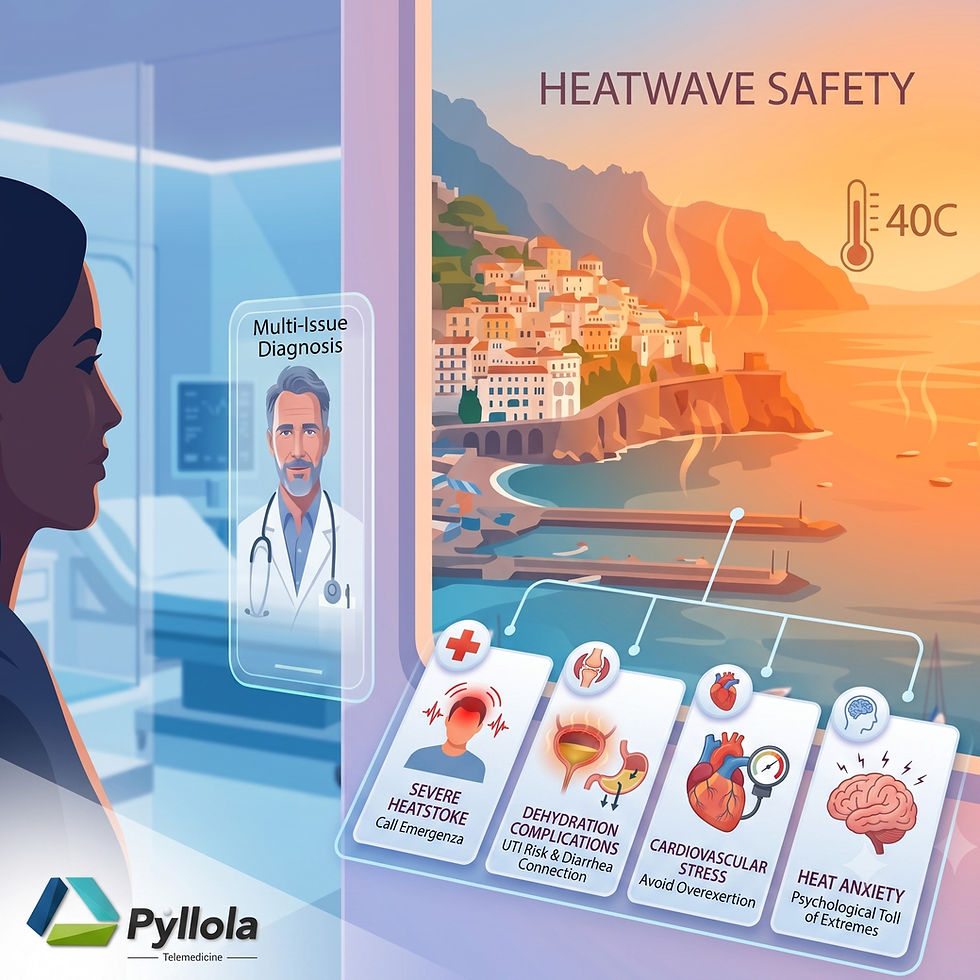
Extreme heat rarely attacks only one system. The body, struggling to cool down through sweating and vasodilation, triggers a cascading series of vulnerabilities. Our infographic breaks down four major, interrelated issues that travelers frequently face during Italian heatwaves, all of which are rooted in dehydration.
Major Health Risks from Dehydration and High Heat
Severe Heatstroke
This is a medical emergency. When the body's internal thermostat fails, core temperatures can spike. This leads to symptoms like severe headache, high body temperature, confusion, and red, dry skin. The risk is compounded by physical activity during the hottest hours (11:00 AM – 4:00 PM).
The Dehydration Blindspot: Why Colder Country Travelers Face Higher Risk
If you are a traveler visiting Italy from a historically cooler climate - such as the United Kingdom, Germany, Scandinavia, Canada, or the Northern United States - your physiological baseline is fundamentally unacclimatized to Mediterranean extremes.

Physiological Habituation & The Thirst Deficit
Research in environmental medicine reveals that unacclimatized individuals suffer from a significant deficit in voluntary fluid intake. In colder climates, individuals are physiologically habituated to lower baseline sweat rates and higher core-to-skin thermal thresholds. When suddenly introduced to a 40°C environment, an adult can easily lose 1.0 to 2.0 liters of fluid per hour purely through perspiration and respiration, depending on exposure and movement levels [Centers for Disease Control and Prevention (CDC) Yellow Book].
However, studies published in environmental health and sports medicine literature demonstrate that the human thirst mechanism is a delayed regulatory response. During abrupt heat exposure, the sensation of thirst does not trigger until a body has already lost roughly 1% to 2% of its total body weight in water - a threshold at which cognitive focus, vigilance, and physical endurance already begin to measurably decline [The Hydration Equation, Nutrition Reviews].
For a traveler from a colder country, this "voluntary dehydration" window is heavily amplified. Because they are unable to accurately estimate sudden sweat loss, self-assessments underestimate their physiological fluid deficit by up to 42% [Journal of Sports Sciences / CIEAH Studies].
Relying solely on thirst as a guide frequently leads to significant underhydration, causing travelers to feel perfectly fine until systemic dehydration has already set in [Georgia Institute of Technology, Exercise Physiology Laboratory].
Is Tap Water Safe in Italy?
You can safely increase your fluid intake using public tap water (acqua del rubinetto), which is strictly regulated and safe across Italy. Many cities even offer free, cold water through public fountains, such as Rome’s nasoni.
🚰 Can I drink tap water in Italy? Read our detailed guide on Drinking Tap Water in Italy to learn about mineral safety and regional exceptions..
Cardiovascular Stress
To release heat, your heart must work harder to pump blood to the surface of the skin. Dehydration thickens the blood, making the heart’s job even more difficult. This increased stress can lead to complications, particularly in those with underlying conditions.
Heat Anxiety
High, persistent temperatures affect not just physical health, but mental well-being. "Heat Anxiety" describes the psychological toll of unrelenting extremes. The combination of discomfort, poor sleep, and reduced physical and cognitive performance can lead to significant stress, anxiety, and exhaustion.
The Urinary Tract Infection (UTI) Threat
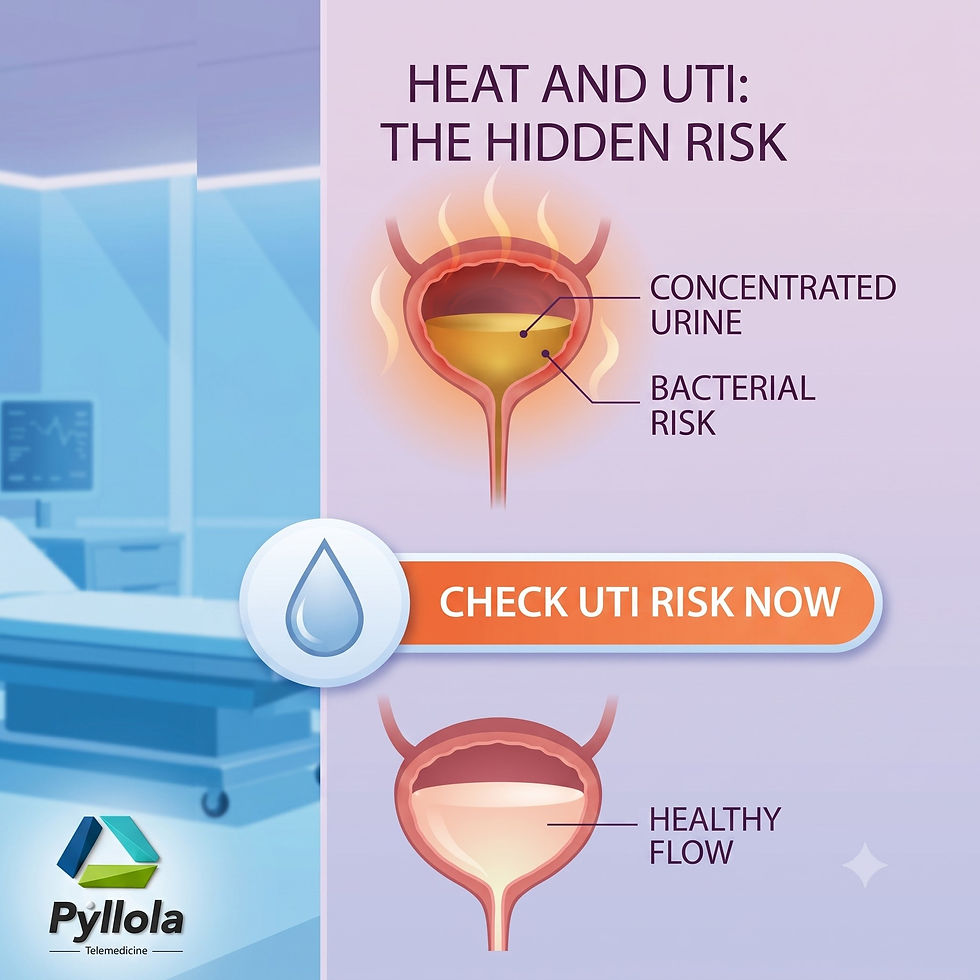
As systemic water volume drops, your kidneys work to conserve fluid, resulting in highly concentrated, dark urine. This concentrated urine acts as an acute chemical irritant to the lining of your bladder and urinary tract.
More critically, decreased fluid intake results in infrequent urination. The urinary tract relies on regular, high-volume flushing to mechanically expel invading bacteria (such as E. coli). Without this internal flushing mechanism, bacteria pool and multiply rapidly within the bladder, triggering a painful, sudden-onset UTI.
🔍 Unsure of your symptoms? Don't guess while abroad. Click to access our medical UTI Risk Checker to evaluate your baseline immediately.
The Travelers' Diarrhea Compounding Effect

An upset stomach or a mild case of travelers' diarrhea (la vendetta di Montezuma) is a common vacation nuisance. However, during an intense heatwave, mild diarrhea shifts from an inconvenience to a medical emergency.
Diarrhea rapidly depletes your extracellular fluid volumes and critical electrolytes (sodium, potassium). When you combine this rapid internal fluid loss with the massive external fluid loss caused by high sweat rates, your body hits a dangerous dehydration threshold within hours.
🧮 Calculate Your Intake: High temperatures demand customized solutions. Use our interactive Water Intake Calculator to determine exactly how many liters your body requires based on the current local temperature.
Sick in Italy? Get English Care, Right Away
If you or a loved one begin displaying symptoms of severe heat distress, an agonizing UTI, or persistent gastrointestinal issues, navigating a foreign medical system shouldn't stand in your way.
Trying to locate a local clinic (Guardia Medica) or waiting for hours inside a crowded public emergency room (Pronto Soccorso) in an unfamiliar city only amplifies your health risks.
Pyllola eliminates the language barrier and geographic friction entirely. Our secure, encrypted telemedicine platform instantly connects you face-to-face with fully licensed, bilingual physicians straight from your smartphone or laptop browser.
Zero Friction: No app downloads, account creation, or password setups required.
Official Care: Receive valid medical certificates and official digital prescriptions accepted at 100% of local Italian pharmacies.
Don't let a heatwave compromise your Italian journey. Stay ahead of your hydration, track your symptoms, and know that professional medical support is available at the click of a button.
🩺 Need to speak with a doctor? Connect to an English-Speaking Physician Now
References
CDC Yellow Book (2026 Edition): Heat and Cold Illness in Travelers. National Center for Biotechnology Information (NCBI) Bookshelf. (Documenting sweat losses reaching up to 1 L/hour under ambient heat stress).
Nutrition Reviews / PMC (NIH): The Hydration Equation: Update on Water Balance and Cognitive Performance. (Confirming the 1%–2% body water loss threshold for thirst stimulation and corresponding cognitive degradation).
Journal of Sports Sciences / CIEAH: Voluntary Dehydration in Runners Despite Favorable Conditions for Fluid Intake. (Demonstrating that individuals routinely underestimate sweat losses by ~42.5%, creating an immediate intake deficit).
Georgia Institute of Technology (Exercise Physiology Lab): Acclimation and Hydration Are Keys to Beating Summer Heat. (Showing that relying solely on thirst as a guide leads to underhydration by nearly 50% in unacclimatized individuals).