"Guardia Medica" vs. "Pronto Soccorso": Where Should You Actually Go When Sick in Italy?
Updated: Aug 6
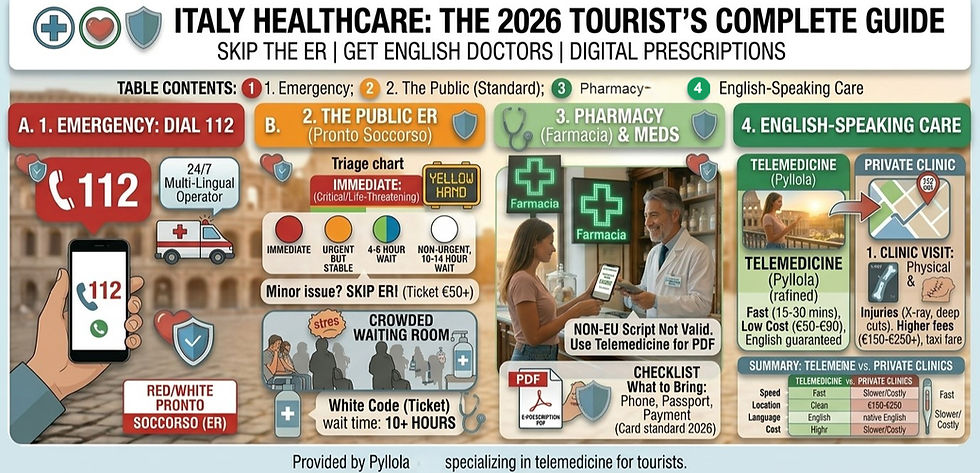
Here’s the short answer: If you’re having a life-threatening emergency, go straight to the Pronto Soccorso (or dial 112).
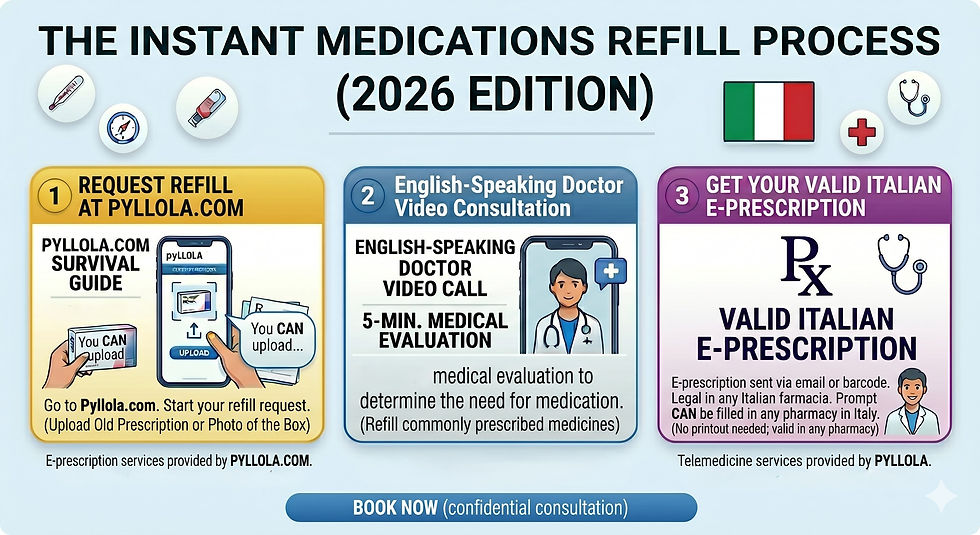
If you have a non-life-threatening illness like a UTI, strep throat, ear infection, or need a prescription refill, bypass the public healthcare maze entirely and see an English-speaking doctor online in 30 minutes.

When you get sick or injured while traveling in Italy, trying to navigate the Italian healthcare system as a foreigner can feel overwhelming. Between language barriers, complex public clinic hours, and 6-hour emergency room waits, knowing where to turn is key.
Here is a simple breakdown of how Italian medical care works - and how to pick the right option so you don't waste your vacation in a waiting room.
The Decision Flowchart: Where to Go?
1. Pronto Soccorso (Hospital Emergency Room)
Best for: Life-threatening emergencies, severe trauma, suspected fractures, or acute chest pain.
How it works: Italian ERs use a color-coded triage system (Red/Orange = critical; Blue/Green = urgent; White = non-urgent).
The Tourist Trap: If you arrive with a "White Code" issue (e.g., ear infection, traveler’s diarrhea, mild fever, or a lost prescription), you will be placed at the very bottom of the queue. You can easily spend 4 to 10 hours in a crowded waiting room surrounded by sick patients before seeing a doctor.
2. Guardia Medica (Out-of-Hours Public Doctors)
Best for: Basic, non-emergency care during nights and weekends when regular Italian GPs are off duty.
How it works: These public walk-in clinics are run by local health authorities (ASL).
The Drawbacks for Tourists:
They are closed during normal daytime hours on weekdays.
Most physicians working at local Guardia Medica clinics do not speak fluent English.
You often need an Italian Tax ID (Codice Fiscale) or complex paperwork to register for care.
3. Pyllola (On-Demand Telehealth for Travelers)
Best for: Non-life-threatening illnesses, sudden infections, sunburns, stomach bugs, eye/ear issues, and prescription conversions.
How it works: Jump on a browser-based video call from your smartphone or laptop. No app downloads, accounts, or Italian tax IDs needed.
Why it’s the smart choice:
100% English-Speaking: Speak directly to a licensed Italian GP who understands foreign travel health concerns.
Instant Legal Prescriptions: Get an official European e-prescription (Ricetta Bianca) sent straight to your phone as a barcode to pick up medication at any local Farmacia across Italy.
Zero Travel Lost: Get diagnosed and treated from your hotel room or Airbnb bed in under 30 minutes.
At-a-Glance Comparison
Feature | Pronto Soccorso (ER) | Guardia Medica | Pyllola (Telehealth) |
Primary Use | Severe Emergencies | Basic Night/Weekend Care | Urgent Non-Emergency Care |
English Spoken? | Hit-or-miss | Rarely | 100% Guaranteed |
Typical Wait Time | 3 to 10 Hours (White Code) | 1 to 3 Hours | Under 30 Minutes |
Location | Local Hospital | Public ASL Clinic | Anywhere on your phone |
Italian Tax ID Needed? | No (Emergency care) | Usually required | No |
Issues Local Prescriptions? | Yes | Yes | Yes (Digital Barcode e-prescription) |
When to Use Pyllola Instead of Waiting
If you're dealing with any of these common travel health issues, skip the hospital queue:
Sinus, Throat, or Ear Infections (Strep throat, swimmer's ear, flight pressure pain)
Urinary Tract Infections (UTIs)
Food Poisoning & Stomach Bugs (Traveler's diarrhea, nausea, vomiting)
Rashes, Sunburns & Bug Bites
Converting Foreign Prescriptions (Converting US/UK/non-EU prescriptions to valid Italian Ricetta Bianca)
Need to speak with an English-speaking doctor in Italy right now? Book a consultation on Pyllola - no app downloads required.