English-Speaking Doctors in Italy: How to Find Fast, Reliable Care
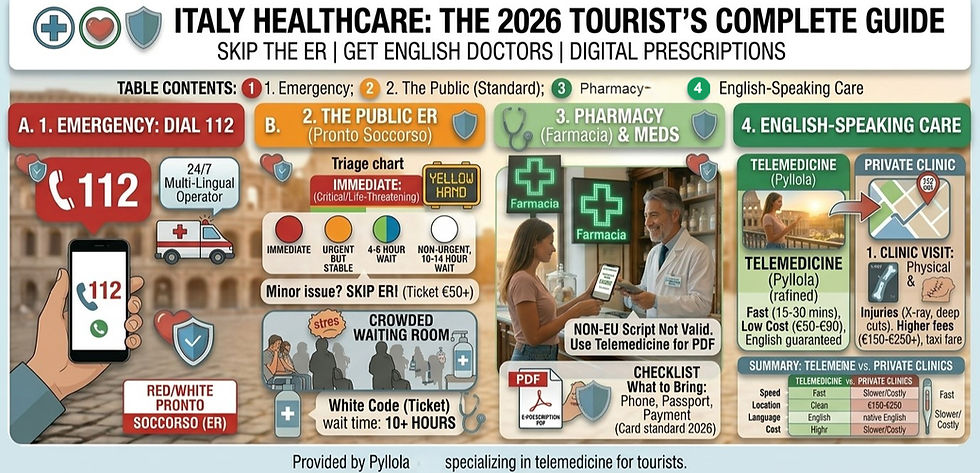
In a medical crisis, nuances matter. Describing a 'dull ache' versus a 'sharp pain' can be the difference between a simple prescription and an unnecessary ER visit. If you are struggling to communicate with local clinics, you aren't just facing a language barrier - you're facing a medical risk. Here is how to find a fluent English-speaking doctor in Italy today. You have three main options: 1) The crowded public ER (Pronto Soccorso), 2) Finding a private local clinic, or 3) Using Pyllola's 15-minute telemedicine service. Here is how to choose the right one for you.

Method | Best For... | Language | Wait Time | Cost |
Public ER (112) | Life-threatening emergencies | Medical Italian | 10–14 Hours | Low/Free |
Private Clinic | In-person exams, X-rays | Functional English | 1–3 Days | High (€150+) |
Pyllola (Telemed) | UTIs, Refills, Flu, Rashes | Native-Level Fluency | 15-30 Mins | Fixed (€89) |
Why an English-Speaking Doctor is Non-Negotiable

Clear communication is the foundation of safe healthcare. When you can’t accurately describe your symptoms, the risk of misdiagnosis or incorrect treatment skyrockets. For international travelers, finding a doctor who speaks fluent English isn't just about comfort - it’s about ensuring medical accuracy and personal safety in an unfamiliar environment.
The Challenges of Seeking Care in Italy
Italy offers world-class healthcare, but navigating it as a tourist presents three major hurdles:
The Language Barrier: Describing a complex medical history or understanding specific dosage instructions is difficult when there is no common language. This often leads to "medical errors" simply due to lost nuances.
System Complexity: Italian healthcare protocols and cultural norms often differ from those in the US, UK, or Canada. Without a guide, understanding where to go - and which forms to sign - can be overwhelming.
Booking Frustrations: Most local appointments are made via Italian-only websites or phone lines. Finding an English-speaking receptionist is rare, making the simple act of booking a visit a significant stressor.
Where to Find Help (And When to Avoid the Hospital)
Finding a local physician requires a strategic approach. Here is how to navigate your options:
Hospitals & Clinics
Many large institutions in major cities (like Rome or Milan) have English-speaking staff, but there are caveats:
The ER Reality: Public Emergency Rooms (Pronto Soccorso) are often overcrowded. Unless you have a life-threatening injury, you may face 10+ hour waits. Furthermore, the triage staff on duty may not be fluent in English.
Researching Ahead: Online directories can list language capabilities, but information is often outdated. Calling ahead is recommended, though difficult if you don't speak the local language.

Online Resources & Digital Tools
The most efficient way to bridge the gap in 2026 is through digital health platforms.
Online Video Calls: This is the fastest way to get a consultation. Speaking to a doctor via video removes the travel time and the stress of navigating a physical clinic.
Directories: While some directories exist, they are often written in Italian. Look for platforms specifically designed for expats and tourists that offer English-first interfaces and support.
Searching for a 'doctor near me' in Italy often leads to Guardia Medica (out-of-hours) stations where English isn't guaranteed, or private specialists with 3-day wait times. For travelers, 'near me' should mean on your phone.
Why Pyllola is the Preferred Choice for Tourists
While there are several virtual providers in Italy, Pyllola is uniquely engineered for the international traveler.

Translating Your Meds: The 'Mapping' Advantage:
An English-speaking doctor at Pyllola doesn't just treat you; they 'map' your home medications (like Tylenol, Advil, or specific antibiotics) to their Italian equivalents (like Tachipirina, Moment, or Normix). This prevents dosage errors and ensures you get exactly what you need at the Farmacia
The Pyllola Advantage:
7-Day Access: Illness doesn't take the weekend off. We provide access to medical experts every day of the week, anywhere in Italy.
Zero Technical Friction: Our cutting-edge platform works directly in your mobile browser. There are no apps to download, no registrations, and no software to install.
Travel-Specific Expertise: Our doctors aren't just experts in medicine; they are experts in the Italian medical system. They understand which local medications are equivalent to your home prescriptions.
Valid E-Prescriptions: With one click, you receive a legal Italian e-prescription on your smartphone that is accepted at every Farmacia in the country.
Total Safety: Avoid crowded, germ-filled waiting rooms. Get diagnosed from the safety and comfort of your hotel room or Airbnb.
Understanding Telemedicine in Italy
If you’ve never used a virtual doctor, you might wonder how it works - especially in a foreign country. Telemedicine (or Telehealth) is the practice of caring for patients remotely using secure video and digital technology. In 2026, it has become the gold standard for travelers who need reliable care without the logistical nightmare of navigating a foreign hospital.
How Telemedicine Works
Telemedicine is more than just a video chat; it is a clinical ecosystem designed for remote accuracy:
Real-Time Consultations: Secure, high-definition video calls allow doctors to observe physical symptoms (like rashes or throat inflammation) and discuss medical history in real-time.
Store-and-Forward: This allows you to securely upload photos of symptoms or previous medical records so the doctor can review them before or during your call.
Remote Guidance: While a physical exam has its limits, modern telemedicine allows doctors to guide patients through self-checks (like checking for tenderness or measuring a pulse) to aid in diagnosis.
The Evolution of Care
While telemedicine saw a massive surge during the COVID-19 pandemic for screening and triage, its uses in 2026 have expanded significantly. Today, it is used for:
General Wellness: Managing chronic conditions like blood pressure or asthma while away from home.
Mental Health: Providing a familiar, English-speaking environment for counseling or psychiatric follow-ups.
Non-Emergency Urgent Care: Treating "vacation spoilers" like UTIs, flu symptoms, and allergic reactions instantly.
The Bottom Line: Communication is Care
Effective communication is the only way to ensure an accurate diagnosis and a safe treatment plan. By breaking down the language barrier through professional English-speaking telemedicine, you take control of your health journey.
Don't let a language gap stand between you and your recovery. Whether it’s a quick prescription refill or a detailed consultation, the right help is now just a click away.