Telemedical Urgent Care for tourists - A Guide to Quality Healthcare
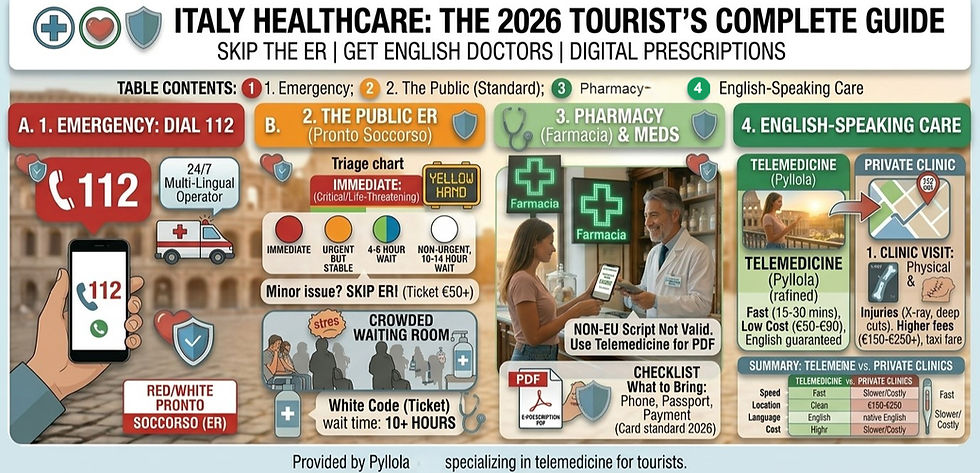
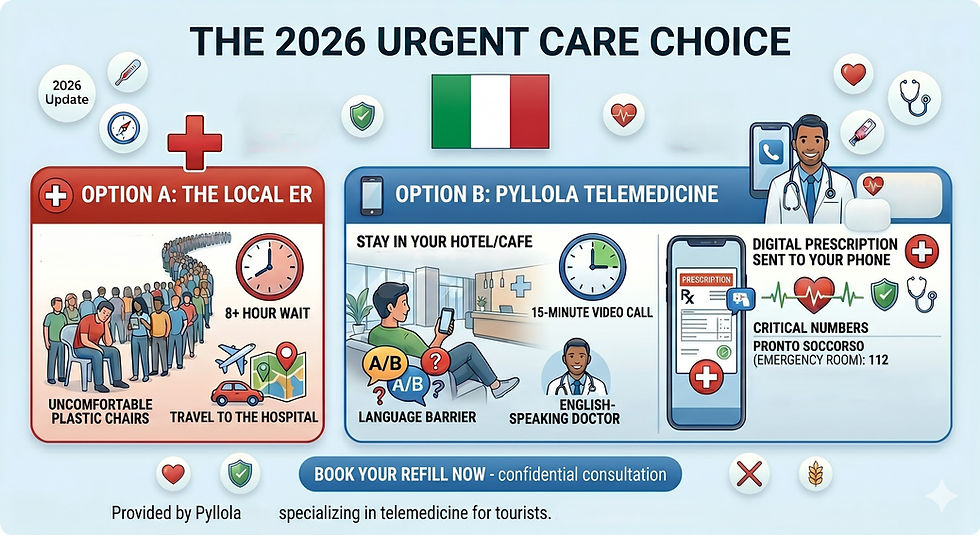
In 2026, waiting times in major Italian cities like Rome, Milan, and Florence for 'Codice Bianco' (non-emergency) cases can exceed 8-10 hours. Telemedical Urgent Care isn't just a convenience; it's the only way to avoid losing a full day of your vacation in a waiting room.
Understanding the Difference Between Urgent Care and Emergency Care
It's important to understand the difference between urgent care and emergency care to ensure that you seek the appropriate medical attention for your condition. While both provide critical services, they cater to different needs and severity levels.
Urgent care services are designed to address non-life-threatening conditions that require immediate attention but are not severe enough to warrant a visit to the emergency room. These conditions may include UTI relief in Italy," "Pink eye treatment," "Severe Sunburn," "Ear infection from swimming," "Stomach flu (Norovirus) recovery, common illnesses like colds or flu, infections, minor burns, mild anxiety disorders or mild to moderate allergic reactions.
Emergency care is reserved for severe or life-threatening conditions that require immediate medical attention. These may include chest pain, severe injuries, difficulty breathing, major burns, Severe allergic reactions, or symptoms of a stroke. Emergency rooms are equipped with advanced medical technology and highly trained staff to handle critical situations and provide life-saving interventions. In Italy the emergency call number to call an ambulance is 112.

Benefits of Telemedical Urgent Care Services
Unlike clinics with fixed hours and primary care physicians with limited appointments, telemedicine platforms and urgent care centers (often via telehealth) offer prompt medical consultations on demand. This allows you to seek timely care when and where you need it, avoiding long ER waits for non-critical issues and overcoming the scarcity of doctors, especially English-speaking ones, in rural areas. This ensures your travels are less disrupted.
Telemedicine (Telehealth)
Globally, healthcare systems have undergone a significant transformation, accelerated by the Covid-19 outbreak, with telemedicine at the forefront. This move towards remote medical care is clearly illustrated by the USA's experience, where telehealth adoption reached around 25% of patients in 2023 and is anticipated to double or even triple in the near future, signaling a fundamental change in how healthcare is accessed and delivered. and those numbers are expected to reach 50-70% in the next few years.
Numerous scientific studies confirm that online doctor consultations (telemedical urgent care) deliver quality of care comparable to in-person visits, often with better outcomes, especially beneficial for tourists in Italy needing urgent medical advice. Embraced globally for its advantages in urgent care, telemedicine eliminates waiting times and travel, providing prompt access to English-speaking doctors who can fully focus on your concerns during a dedicated video consultation, ensuring efficient and effective healthcare while you're away from home.
In a systematic review (1) researchers looked at quality of care (QoC) in patients having both hypertension and diabetes and made a valuation of effects of telemedicine on QoC. they concluded that 'Telemedicine has great potential to improve the QoC, particularly outcomes of care, for patients with hypertension and comorbid diabetes. Health care professionals may consider using available telemedicine to facilitate communication and interaction with their patients, thereby helping them with disease management.'. Another study comparing Telemedicine to in-person medical care and included over 500,000 patients (2) concluded 'there was a largely favorable association with quality of primary care. This supports telemedicine's value potential for augmenting care capacity, especially in chronic disease management and preventive care'.

A systemic literature review (3) on Telemedicine QoC found 'The effectiveness of telemedicine is equal to or greater than that of traditional care across a wide spectrum of services studied in this systematic literature review'. In another study that examined telemedicine in headache care, authors found that 'Telemedicine consultations are similar in quality to traditional in-office headache consultations and can be a more convenient solution for eligible headache patients'.
A review looking at patient and provider satisfaction with telemedicine (TM) (4) found 'Patients consistently report 95-100% satisfaction rate with TM when compared with in-person appointments. They tend to cite the convenience of decreased travel times and costs as the main drivers for satisfaction with TM, Providers tend to be satisfied with TM if they have input into its development, there is administrative support, the technology is reliable and easy to use, and if there is adequate reimbursement for its use'.
For travelers in Italy, urgent care services, especially telemedicine options, offer significant advantages: unparalleled convenience, drastically shorter waiting times compared to emergency rooms, and accessibility anytime, often 7 days a week.
Common Medical Conditions Treated by Urgent Care professionals
Urgent care providers are trained to handle a wide range of non-life-threatening medical conditions. These facilities often have experienced medical professionals who can diagnose and treat various illnesses and injuries promptly. Some of the most common conditions treated by doctors who are trained giving urgent care include:
Minor injuries: Urgent care experts can handle minor injuries such as cuts, sprains, strains, and minor fractures. Medical centers that use telehealth can also be impressed by the severity of the injury, given it is a video-call, so they can provide the necessary treatments.
Illnesses: Urgent care centers can diagnose and treat common illnesses like colds, flu, strep throat, sinus infections, and urinary tract infections. They can also provide prescription medications.
Infections: Whether it's a skin infection, ear infection, or respiratory infection, urgent care centers can provide appropriate treatment, including antibiotics if necessary.
Allergic reactions: If you're experiencing a mild to moderate allergic reaction, urgent care centers can administer antihistamines or other treatments to alleviate your symptoms.
Anxiety: Anxiety is a surprisingly common ailment among travelers, and Italy, with its rich tapestry of new sights, sounds, and logistical challenges, can sometimes be a trigger. The stress of long international flights, navigating unfamiliar public transportation in Rome or Florence, communicating in a foreign language, and simply being outside one's comfort zone can all contribute to heightened anxiety levels.
These examples illustrate the range of medical issues readily addressed by urgent care services and telemedicine doctors experienced in providing prompt care. While best suited for immediate, non-life-threatening conditions, especially convenient for short-term travelers, urgent care complements your primary doctor and ensures you receive timely assistance during your stay in Italy. Always follow up with your GP upon your return..

Urgent Care for Tourists in Italy: How to Find the Right Online Medical Help
Choosing the right urgent care provider is crucial to receiving quality healthcare. Here are some factors to consider when making your decision:
Location: Look for an urgent care center that is conveniently located near your home or workplace. This will ensure that you can easily access medical care when needed. Telemedical services that consist in making a video call from your phone, tablet or computer eliminate the issue of location since you can stay wherever you are and conduct the call. In fact, Pyllola Telemedicine’s experts can provide many testimonials that many tourists in Italy are making those calls in the middle of the street, in railway stations, airports or monuments.
Operating hours: Consider the operating hours of the urgent care center. Look for one that offers extended hours, including evenings and weekends, to accommodate your schedule. Telemedicine services usually have extended hours, operating from early morning to late at night.
Services offered: Assess the range of services offered by the urgent care center. Ensure that they cover the conditions you are most likely to seek treatment for.
Medical professionals: Research the qualifications and experience of the medical professionals working at the urgent care center. Look for licensed physicians, nurses, and other healthcare providers who have expertise in urgent care.
5. Insurance acceptance: Check whether the urgent care center accepts your insurance plan. This will help minimize out-of-pocket expenses.
6. Facility amenities: Consider the amenities available at the urgent care center. Some centers may offer on-site laboratory services, imaging facilities, or pharmacies, which can enhance the convenience of your visit.
Tips for Maximizing Your Urgent Care Visit
To make the most of your urgent care visit and ensure a smooth experience, keep the following tips in mind:
Prepare necessary documents: Be sure to have any relevant medical records or medications that you are taking on a regular basis. This will help expedite the diagnosis formulation by the medical doctor and ensure accurate medical treatment.
Make a list of symptoms and concerns: Before your visit, jot down any symptoms you're experiencing or concerns you have. This will help you communicate effectively with the healthcare provider and ensure that all your questions are addressed.
Be honest and thorough during the evaluation: Provide the healthcare provider with accurate and complete information about your symptoms, medical history, and any medications or allergies you have. This will aid in accurate diagnosis and appropriate treatment.
Ask questions: Don't hesitate to ask questions if you have any doubts or need clarification about your condition or treatment plan. Understanding your healthcare provider's recommendations is essential for your well-being.
Follow instructions and treatment plans: After your visit, carefully follow the instructions and treatment plans provided by the urgent care center. This may include taking prescribed medications, following wound care instructions, or scheduling follow-up appointments.
By following these tips, you can ensure that your urgent care visit is efficient, effective, and beneficial for your health. You can also have a look at our post on how to prepare for a successful telemedicine visit here.

Conclusion:
Urgent care services remain crucial for providing efficient and accessible health care to tourists and travelers exploring Italy.
The future of urgent care is increasingly intertwined with technological advancements, particularly the growing integration of telemedicine.
Travelers can anticipate even greater convenience through remote medical consultations, allowing access to healthcare professionals from anywhere in Italy, especially beneficial in remote areas or when seeking immediate assistance without the need to locate a physical clinic. Furthermore, the application of artificial intelligence and machine learning in urgent care is poised to enhance diagnostic accuracy and personalize treatment plans, leading to improved patient outcomes. Overall, the evolution of urgent care promises enhanced healthcare accessibility and more effective treatment for non-life-threatening conditions, ensuring travelers can promptly address health concerns and continue enjoying their Italian experience with greater peace of mind.
References:
Zhang W, Cheng B, Zhu W, Huang X, Shen C. Effect of Telemedicine on Quality of Care in Patients with Coexisting Hypertension and Diabetes: A Systematic Review and Meta-Analysis. Telemed J E Health. 2021 Jun;27(6):603-614. doi: 10.1089/tmj.2020.0122. Epub 2020 Sep 23. PMID: 32976084.
Baughman DJ, Jabbarpour Y, Westfall JM, Jetty A, Zain A, Baughman K, Pollak B, Waheed A. Comparison of Quality Performance Measures for Patients Receiving In-Person vs Telemedicine Primary Care in a Large Integrated Health System. JAMA Netw Open. 2022 Sep 1;5(9):e2233267. doi: 10.1001/jamanetworkopen.2022.33267. PMID: 36156147; PMCID: PMC9513647.
Kruse CS, Molina-Nava A, Kapoor Y, Anerobi C, Maddukuri H. Analyzing the Effect of Telemedicine on Domains of Quality Through Facilitators and Barriers to Adoption: Systematic Review. J Med Internet Res. 2023 Jan 5;25:e43601. doi: 10.2196/43601. PMID: 36602844; PMCID: PMC9893735.
Nguyen M, Waller M, Pandya A, Portnoy J. A Review of Patient and Provider Satisfaction with Telemedicine. Curr Allergy Asthma Rep. 2020 Sep 22;20(11):72. doi: 10.1007/s11882-020-00969-7. PMID: 32959158; PMCID: PMC7505720.
Uscher-Pines, L., Sousa, J., Raja, P., Mehrotra, A., Riley, G., & Teleki, S. S. (2020). Telemedicine Use Among Medicare Beneficiaries Before and During the COVID-19 Pandemic: A Repeated Cross-Sectional Study. Journal of General Internal Medicine, 35(10), 2871–2877.
Bashshur, R. L., Shannon, G., Krupinski, E. A., & Bashshur, N. (2016). The empirical evidence for telemedicine interventions in diabetes management. Telemedicine and e-Health, 22(11), 879–899.
Egede, L. E., & Miller, D. R. (2010). Telemedicine for chronic disease management. American Journal of Medicine, 123(12), 1104-1110.
Eysenbach, G. (2001). Telemedicine and telecare: opportunities and challenges in patient care and public health. Journal of medical Internet research, 3(2), E11.