Healthcare for Tourists in Italy: How to Access Medical Care
Visiting Rome, Florence, or the Amalfi Coast and suddenly feeling unwell? Navigating a foreign medical system, language barriers, and prescription rules can feel overwhelming. Here is everything you need to know about hospitals, pharmacies, emergency numbers, and how to see an English-speaking doctor in Italy without waiting in an ER.
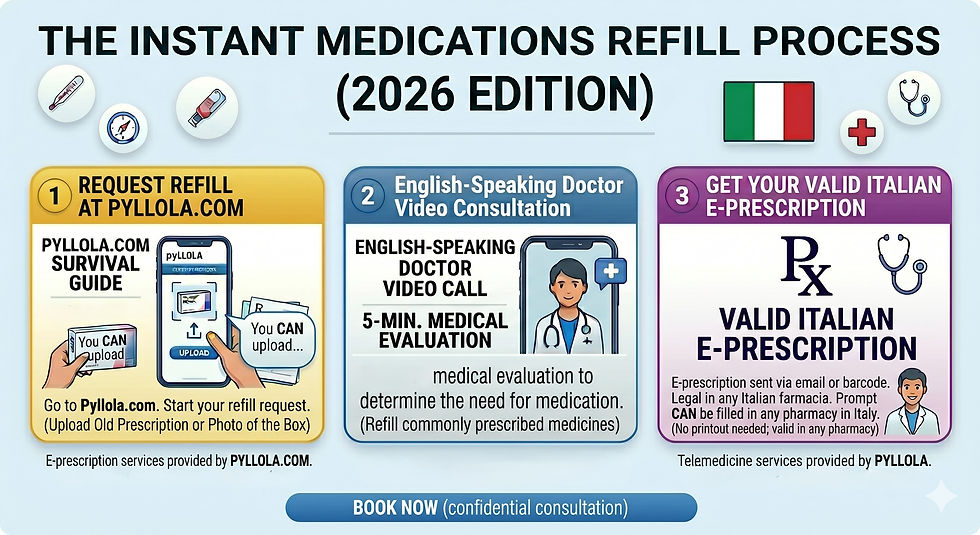
🚨 NEED NON-EMERGENCY MEDICAL CARE IN ITALY? Public hospital emergency rooms (Pronto Soccorso) prioritize life-threatening trauma and often involve 4 to 8 hour waits for minor ailments. Furthermore, Italian pharmacies cannot legally accept foreign prescriptions.Skip the waiting room: Book an Online GP Visit with Pyllola. Connect with an English-speaking, Italian-licensed physician via video in minutes and receive an official Italian e-prescription sent straight to your smartphone.
Italy Healthcare at a Glance: Where Should You Go?
Medical Situation | Best Place to Go | Expected Cost | Language |
Severe Trauma / Acute Emergency | Hospital ER (Pronto Soccorso) or Call 112 | Free or low co-pay (ticket) | Mostly Italian |
Minor Illness, Infection, Refills | Pyllola Telemedicine (Online GP) | Fixed private fee (Insurance reimbursable) | 100% English |
Minor Cold, Bites, Motion Sickness | Local Pharmacy (Farmacia) | OTC retail price | Basic English common |
Severe Toothache / Broken Tooth | Private Dentist (Dentista Privato) | €100 – €250 out of pocket | Variable |
1. Emergency Medical Care: Dial 112 & Pronto Soccorso
For life-threatening emergencies, dial 112 immediately. This is the universal European emergency number connecting you to ambulance (ambulanza), police, and fire rescue.
How Hospital Emergency Rooms (Pronto Soccorso) Work
Public hospital ERs are open 24/7 and treat anyone regardless of nationality or insurance coverage. However, they operate on a color-coded triage system:
Red / Orange Codes (Life-Threatening): Immediate admission; treatment is completely free under Italian law.
Blue / Green / White Codes (Non-Urgent Conditions): Flu, ear infections, minor cuts, or mild stomach bugs are deprioritized. You will face wait times of 4 to 8 hours and will receive a "Ticket" (co-pay invoice) upon discharge, typically ranging from €25 to €150.

2. Over-the-Counter Care at Italian Pharmacies (Farmacie)
For mild, everyday complaints, look for the illuminated green cross. Italian pharmacists (farmacisti) hold advanced degrees and can recommend effective over-the-counter (OTC) treatments.
Important Prescription Rules:
Foreign Prescriptions Are Not Accepted: Italian pharmacies cannot legally dispense prescription medications (like antibiotics, high-dose pain relievers, or daily maintenance drugs) using a US, Canadian, Australian, or non-EU prescription.
Getting a Valid Local Script: If you lost your medication or need an antibiotic, you must obtain a digital prescription from an Italian-registered physician. Pyllola's doctors can issue an official electronic prescription (ricetta elettronica) directly to your phone, accepted at every pharmacy nationwide.
3. Visiting a General Practitioner vs. Private Clinics
If your condition is non-urgent but requires a doctor’s assessment:
Public GPs (Medici di Base): Public family doctors in Italy primarily serve registered residents. Many do not accept walk-in foreign tourists and rarely speak fluent English.
Tourist Medical Outposts (Guardia Medica Turistica): Available in some resort towns during peak summer months, but hours are restricted (often night-only) and queues can be long.
Private Clinics (Cliniche Private): Private clinics provide faster access and often have multilingual staff. However, standard in-person consultation fees range from €120 to €300, paid upfront.
4. Why Telemedicine is the Most Practical Option for Travelers
Unless you need physical immobilization for a fracture or surgical intervention, traveling to an unfamiliar Italian clinic wastes precious vacation time.
Through Pyllola, international travelers and expats access hassle-free healthcare:
Immediate Video Consultations: See a doctor from your hotel room or Airbnb within minutes.
Fluent English Communication: Discuss your symptoms, allergies, and medical history without translation errors.
Instant Digital Prescriptions: Collect your prescribed medication at any local farmacia by simply displaying the barcode on your screen.
Insurance Receipts: Receive an itemized invoice (fattura) and clinical summary ready for submission to your travel insurance provider for prompt reimbursement.

5. Travel Insurance & Billing by Nationality
Do U.S., Canadian, or Australian Citizens Get Free Healthcare?
No. Non-EU citizens do not have access to Italy’s public healthcare network free of charge. While emergency stabilization is never denied, you will be billed for treatment and hospital stays. Comprehensive travel medical insurance is strongly advised.
European Union & UK Travelers
EU Citizens: Carry a valid European Health Insurance Card (EHIC) to access public healthcare under the same conditions as Italian citizens (paying standard co-pays where applicable).
UK Citizens: A valid UK Global Health Insurance Card (GHIC) or remaining EHIC covers medically necessary state healthcare during temporary visits.

Healthcare for Tourists in Italy - Frequently Asked Questions
Q: Can I buy antibiotics over the counter in Italy?
A: No. Italian regulations strictly prohibit pharmacies from dispensing antibiotics without an official prescription from an Italian-registered doctor.
Q: How much does an emergency room visit cost in Italy for a tourist?
A: Life-threatening emergencies are treated free of charge. For non-urgent visits (white/green triage codes), tourists are charged a standard co-pay (ticket) ranging between €25 and €150 depending on the diagnostic tests performed.
Q: Will my travel insurance cover an online doctor visit with Pyllola?
A: Yes. Most travel insurance policies cover private outpatient consultations. Pyllola provides official itemized medical receipts and treatment summaries that satisfy insurance claim requirements.