The End of the Waiting Room? Future of Medicine (2026)
Imagine a scenario: It is 2:00 AM. You wake up with a burning fever and a strange rash. Ten years ago, your options were bleak: wait in agony until the morning to call a clinic or rush to a chaotic, germ-filled Emergency Room. Today, however, the script has flipped.
You reach for your smartphone, and within minutes, a board-certified physician is examining you through a high-definition screen, analysing your symptoms and sending a prescription to your nearest 24-hour pharmacy.

We are living through a quiet revolution. It is not just a change in technology; it is a fundamental shift in the philosophy of care. This is the era of Telemedicine (and AI that soon will also be able to assist your physician) - a transition so significant that experts are comparing it to the invention of the stethoscope.
But what does this mean for the patient? Are we trading human touch for algorithmic efficiency? And for the global traveler, how does this shift transform the terrifying experience of getting sick in a foreign land?
The Anatomy of the Shift: Defining Telemedicine
At its core, telemedicine is the remote delivery of healthcare services using telecommunications technology. It allows healthcare professionals to evaluate, diagnose, and treat patients without being in the same physical location.
While the concept dates back to the late 19th century (with the first transmission of an electrocardiogram over telephone lines), the modern iteration is a beast of a different nature. It is no longer just a video call; it is an integrated ecosystem of Remote Patient Monitoring (RPM), wearable technology, and AI-driven diagnostics.
Defining the Terms: It’s Not Just "Zoom for Doctors"
Before diving into the revolution, we must clarify the lexicon, as "Telehealth" and "Telemedicine" are often confused.
Telehealth is the broad umbrella. It includes everything from public health alerts on your phone to administrative meetings between hospital staff.
Telemedicine is the focus of this article - the specific clinical practice of medicine from a distance.
We are not talking about "Remote Patient Monitoring" (where a pacemaker sends data to a server). We are talking about synchronous, doctor-to-patient relationships. It is the restoration of the house call, but the doctor travels via fibre optics instead of a carriage.
The Data: A Global Explosion

The numbers paint a staggering picture of adoption. This is not a temporary trend born of the pandemic; it is the new standard.
United States: The Early Adopter
In the United States, the shift has been seismic. According to a 2025 report by the American Medical Association (AMA), approximately 71.4% of physicians now use telehealth services in their practices on a weekly basis, a figure that has nearly tripled since 2019. Patient satisfaction with telehealth in the US hit 86%, with the primary drivers being convenience and speed. The market for "Acute Care Telemedicine" - treating sudden but minor illnesses - is projected to grow at a Compound Annual Growth Rate (CAGR) of over 17% through 2034.
The "100-Minute" Dividend: Studies show that the average telemedicine visit saves a patient approximately 100 minutes compared to an in-person visit (factoring in travel, parking, and waiting room time).
It is not just doctors who are on board; patients are demanding it. Data indicates that 25% of the US population relies on telehealth apps to mitigate symptoms before ever stepping foot in a clinic. The efficiency is undeniable: the average telemedicine visit saves a US patient over 100 minutes of time compared to an in-person visit (factoring in travel and waiting room time).
The Global Perspective: The US is not alone.

Europe has historically been slower to adopt digital health due to rigid public systems, but the landscape is changing. In Italy, the telemedicine market is expanding rapidly as the public system (Servizio Sanitario Nazionale) struggles with long wait times. The European eHealth market is projected to grow significantly, driven by a need to relieve pressure on overcrowded Emergency Rooms (Pronto Soccorso).
United Kingdom: Surprisingly, the UK leads in senior adoption, with 69% of the senior citizen population utilizing telemedicine applications, largely driven by the National Health Service's (NHS) digital push.
Italy: In Italy, a country traditionally reliant on family doctors (medico di famiglia), telemedicine is estimated to save patients with chronic conditions nearly 9.5 hours per year in travel and waiting time.
Global Market: The global telemedicine market was valued at approximately USD 135 billion in 2024 and is projected to skyrocket to over USD 700 billion by 2034. This exponential growth (CAGR of ~17%) suggests that virtual care will eventually rival physical care in market volume.
The "Dr. Algorithm" Debate: AI in Medicine
The most controversial frontier in this medical revolution is Artificial Intelligence. Browse any physician forum today, and you will find a battleground of opinions.
On one side, Optimists argue that AI is the ultimate assistant. A study reviewing AI integration in 2024 highlighted that AI-powered diagnostic tools can analyse X-rays and dermatological images with accuracy rates often exceeding human physicians. Optimists also argue that human brains are limited by fatigue and cognitive load, while AI is not. Recent data supports this: a 2024 meta-analysis highlighted that AI-powered diagnostic tools - specifically in visual fields like radiology and dermatology - can detect abnormalities with sensitivity rates often exceeding board-certified physicians. For these "needle-in-a-haystack" tasks, the algorithm is undeniably superior.
On the other side, Skeptics - including many practicing physicians on forums like r/medicine - argue that medicine is an art as much as a science and warn that AI "lacks nuance." As one hospital-based physician noted in a viral discussion, "Clinical medicine is a tapestry of subtle signals... A physician's reasoning may pivot on a patient's tone of voice," something AI currently struggles to capture.
However, the consensus is shifting toward a "Hybrid Model." The goal is not for AI to replace the doctor, but to replace the administrative doctor. By handling data entry, preliminary triage, and pattern recognition, AI frees the human physician to return to their core purpose: empathy, complex synthesis, and judgment. The binary of "AI vs. Doctor" is false. The "Hybrid Model" of the Augmented Physician is the reality we should expect. In this future, AI acts as the "left brain" of the clinic - handling the administrative drudgery, coding, and pattern recognition. This liberation allows the human doctor to fully inhabit the "right brain" role: focusing on empathy, ethical judgment, and complex decision-making.
Scientific Consensus: Telemedicine Advantages vs. Limitations
What does the science say? A systematic review of current literature reveals a clear dichotomy.

Advantages of Telemedicine in practical medical care delivery:
Access Equity: Telemedicine breaks down geographical barriers. Studies from rural Nepal to the American Midwest confirm that telehealth significantly reduces travel burdens and improves health access for underserved populations.
Infection Control: As evidenced during the COVID-19 pandemic, remote care minimises the transmission of infectious diseases by keeping contagious patients out of waiting rooms.
Cost-Efficiency: Virtual visits reduce overhead for providers and direct costs (travel, childcare, time off work) for patients.
Limitations of telemedicine
The "Touch" Barrier: You cannot palpate an abdomen or listen to a heart murmur through Zoom. This remains the hard limit of telemedicine, necessitating in-person referrals for complex physical exams.
Digital Divide: Elderly patients or those with poor internet connectivity risk being left behind, creating a new form of health inequality.

The Traveler’s Solution: The Pyllola Revolution
One of the most practical applications of this technology is for the international traveler. Getting sick in a foreign country is a nightmare scenario: language barriers, confusing insurance paperwork, and the dread of navigating a foreign hospital system.
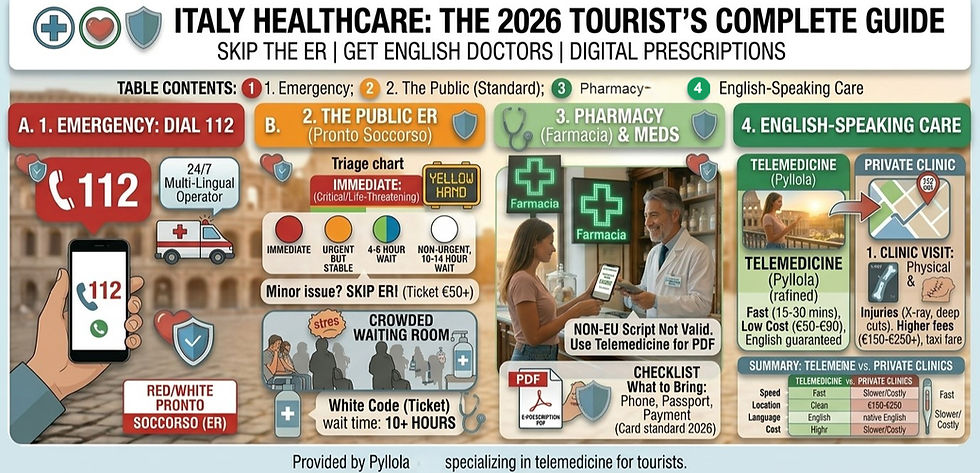
This is where Pyllola.com has emerged as a revolutionary option, specifically tailored for the English-speaking traveler in Italy.
What is Pyllola?
Pyllola (a play on the Italian word for "pill") is a modern, traveler-focused urgent care solution. Unlike generic telemedicine apps, Pyllola is designed to solve the specific logistical hurdles of being a tourist.
Why is it Revolutionary?
Most telemedicine platforms require you to download an app, create an account, verify a local phone number, and navigate complex subscriptions. Pyllola removes this friction entirely:
Zero-Friction Access: It is entirely browser-based. There are no apps to download and no registration required. You simply book a slot, and you are connected. This is crucial for a traveler who might be on hotel Wi-Fi with limited data storage.
The "Prescription Power": A major limitation of using a US-based telehealth doctor while in Europe is that a US prescription is invalid in Italian pharmacies. Pyllola connects travelers with Italian-licensed, English-speaking doctors. They issue a legally valid electronic prescription (Ricetta Elettronica) that can be scanned and filled at any pharmacy in Italy.
Cultural Bridge: The service bridges the gap between Anglo-Saxon expectations of care (efficiency, directness) and the Italian medical system.
For a tourist in Rome or Florence facing a sudden sinus infection or lost medication, this service transforms a potential trip-ending disaster into a 15-minute minor inconvenience. It represents the "best case" future of telemedicine: hyper-specialised, borderless, and user-centric.
The Future of Telemedicine: A New Era of Care
As we look ahead, the landscape of healthcare will continue to evolve. The integration of telemedicine into everyday life will redefine how we access medical care.
The Role of Technology: Advancements in technology will further enhance telemedicine. From improved AI algorithms to better connectivity, the future holds promise. Imagine a world where virtual reality allows doctors to perform remote examinations with unprecedented accuracy.
Patient Empowerment: Patients will have more control over their health. With telemedicine, you can choose your healthcare provider based on reviews and specialisations rather than geographical proximity. This shift empowers you to seek the best care available.
Global Health Initiatives: Telemedicine can play a crucial role in global health initiatives. It can help bridge the gap in healthcare access, especially in underserved regions. By leveraging technology, we can ensure that quality healthcare is available to all, regardless of location.
Conclusion
The question "Who will be your doctor in the future?" has a complex answer. Your doctor will likely be a hybrid entity: part AI-analyst, part human-empath, and accessible from anywhere on the planet.
While forums may debate the "soul" of medicine and skeptics worry about the lack of physical touch, the data is irrefutable. The shift has happened. Whether you are a chronic patient in rural America or a tourist in downtown Rome using Pyllola, the waiting room of the future is in your pocket.
Who will be your doctor in the future? It will likely be a hybrid entity. For your annual physical or severe pain, you will see a human in a room. But for the sinus infection that hits on a Sunday, or the anxiety refill you need while honeymooning in Florence, your doctor will be a voice in your pocket.
Platforms like Pyllola are not replacing the hospital; they are building a bridge over the gap that travelers used to fall into. They prove that in the 21st century, quality healthcare is no longer defined by where you are, but by how connected you are.
Bibliography
Precedence Research. (2024). Telemedicine Market Size, Share, and Trends 2024-2034. Reference Link
J.D. Power. (2024). U.S. Telehealth Satisfaction Study.
Journal of Medical Internet Research (JMIR). (2025). Time and Cost Savings in Telemedicine: A Systematic Review.
Nova One Advisor. (2024). North America And Europe eHealth Market Size and Trends. Reference Link
CareExpand. (2025). Telemedicine Trends: Transforming Patient Care in 2025 (AI and NLP integration). Reference Link
Pyllola. (2025). How It Works: The Traveler-Centric Telemedicine Model. Retrieved from Pyllola.com.
Folio3 Digital Health. (2025). The Future of Telemedicine: Top 10 Trends of 2025. Retrieved from digitalhealth.folio3.com.
American Medical Association (AMA). (2025). New data details how telehealth use varies by physician specialty. AMA Report 2025.
Straits Research. (2024). Top Telemedicine Mobile Apps Globally (2024). Market Analysis Report.
Healthcare Transformers. (2025). Top telehealth trends for 2025: Global Adoption Rates.
WHO Regional Office for Europe. (2024). Telemedicine adoption in the European Union and Italy: Time-savings analysis.
Fortune Business Insights. (2024). Telemedicine Market Size, Share & Growth Report [2032].
Technavio. (2025). Artificial Intelligence In Telemedicine Market Analysis, Size, and Forecast 2025-2029.
Parajuli, R., et al. (2017/2024). Exploring the role of telemedicine in improving access to healthcare services. Telematics and Informatics / Center for Global Digital Health Innovation.
CDC Public Health Law. (2024). Research Anthology: Telehealth and Telemedicine Advantages and Barriers.